ECONOMICS EXAM QUESTIONS FOR SS2 SECOND TERM
SS2 ECONOMICS EXAM QUESTIONS SECOND TERM – EDUDELIGHT.COM
SECOND TERM EXAMINATION
Examination malpractices may lead to a repeat of the subject or suspensions don’t be involved.
SUBJECT: ECONOMICS DURATION: 2HR CLASS: SSS 2
- Which of the following is an economic activity? A. Attending a town’s meeting. B. A visits to the stadium. C. Payment of school fees D. Arresting a petty thief
- Which of the following cost curve is not u-shaped? The (a)marginal cost curve (b)average fixed cost curve (c)average total cost curve (d)average variable cost curve
- Frictional unemployment occurs when (a) there is a change in the techniques of production (b)job seekers lack information where job exists (c)bad weather prevents workers from progressing (d)job seekers have disabilities
- Which of the following will increase the demand for labour?(a)increase wage rate (b)labour demand for output (c)low wage rate (d) low marginal productivity
- Production of firms and Industries is not influenced by(a)availability of raw materials (b)existence of other firms (c)nearness to the source of money supply (d)government policy
- The profit of a producer is the difference between (a)total cost and marginal cost (b)total revenue and total cost (c)average cost and total cost (d)price and total cost
- Cyclical unemployment is the one associated with (a)inadequate information (b)trade fluctuations (c)structural changes (d)seasonal changes
- Perfect knowledge of events in a perfect market will be made possible by the existence of (a)many buyers and sellers (b) homogeneous products (c)means of communication (d) large member of traders
- Which of the following measures will not encourage industrialization in West Africa ?(a)taking over of all forms of industries by the government (b)provision of social infrastructure (c)giving tax incentives especially to infant industries (d)using tariffs to discourage the use of imported items
- In economics, a market is defined as any (a)agreement made for consumers to buy all they need (b)agreement to sell commodity at low prices (c)arrangement made for producers to sell alltheir goods (d)arrangement whereby buyers and sellers are in close contact
- The following constitutes the criteria for identifying an economic system except(a)ownership of resources (b)scarcity of resources (c)method of decision making (d)motivation for production
- The movement of labour from one grade to an entirely different grade is an example of (a)industrial labour mobility (b)horizontal occupational mobility (c) vertical occupational mobility (d)geographical mobility
- Which of the following is not a strong basis for trade union demand for higher wages? The (a)company is making higher profit (b)productivity of the worker has increased (c) members of the union have high qualification (d)commodity produced by the worker is very essential
- An industry is best described as (a)firms that sells a set of closely related commodities (b)a factory that produces different lines of products(c)a group of firms that sell a closely related set of products (d)industrial concern that is into production and selling goods
- Which of the following statement is correct?(a)as total utility increases the marginal utility also increases (b)the marginal utility is always zero whenever the total utility reaches the maximum (c)the total utility is at maximum whenever the marginal utility is at its minimum(d)there is no relationship between total utility and the marginal utility
- Points outside a production possibility curve indicate (a) unattainable production levels (b) attainable production levels (c) inefficient but attainable production levels (d) optimum production levels (a) natural monopoly (b) state monopoly (c) legal monopoly (d) discriminating monopoly
- One of the problems facing industrial development in West African countries is (a) inadequate large market (b) inadequate infrastructure (c) inadequate supply of labour (d) unavailability of natural resources
- The allocation of goods and services in a free market economy is performed by (a) the price system (b) the banking system (c) the central planning body (d) government
- If a firms price is less than average cost but more than average variable cost, the firm is covering (a) all of its fixed cost and variable cost (b) all of its fixed cost and part of variable cost (c) all of its variable cost and part of fixed cost (d) part of its fixed cost and part of variable cost
- The type of monopoly that develops as a result of granting patent right is known as When the marginal product is negative, the total product will be (a) Constant (b) at a maximum (c) increasing (d) decreasing
- A market structure where profit is maximized when marginal revenue, marginal cost and price are equal is known as (a) perfect competition (b) monopoly (c) Oligopoly (d) imperfect competition
- In which of the following markets does a firm have power to make super normal profits both in the short run and long run? (a) monopoly (b) duopoly (c) oligopoly (d) monopoly
- The component of three sector economy are (a)banks, schools and hospital (b)workers, producers and marketers (c)households, firms and the government (d)producers, retailers and wholesalers In the long-run factors of production are considered to be (a)at maximum (b)fixed (c)variable (d) increasing
- Which of the following is the main outcome of a trade union’s interference with the wage rate? Wages are (a) lowered but employment level remains unchanged (b) lowered but more employment opportunities are created (c) increased and employment levels are unchanged (d) increased but employment levels are reduced
- Which of the following statement is not a feature of a monopoly (a) seller is allowed to fix his own price (b) buyers and sellers are price takers (c) new entrances are restricted (d) there is only one seller of the commodity.
- The movement of labour from one grade to an entirely different grade is an example of (a)industrial labour mobility (b)horizontal occupational mobility (c) vertical occupational mobility (d)geographical mobility
- Which of the following is not a strong basis for trade union demand for higher wages? The (a)company is making higher profit (b)productivity of the worker has increased (c) members of the union have high qualification (d)commodity produced by the worker is very essential
- Which of the following statement is correct?(a)as total utility increases the marginal utility also increases (b)the marginal utility is always zero whenever the total utility reaches the maximum (c)the total utility is at maximum whenever the marginal utility is at its minimum(d)there is no relationship between total utility and the marginal utility
- Productive resources can also be called (a) principle of production (b) factors of production (c) items of production (d) labour and material resources.
- Production covers all the following except when (a) utility is created (b) a good is manufactured (c) a commodity is consumed (d) individual want
THEORY: Answer one question only from this section
- The table below shows the various possible combinations of military and civilian goods produced by a country, using the available resources and technology. Use the table to answer the questions the questions that follow.
| Military Goods (in tones) | Civilian Goods (in tones) |
| 0 | 200 |
| 20 | 160 |
| 40 | 120 |
| 60 | 80 |
| 80 | 40 |
| 100 | 0 |
(a) Draw the production possibility curve (PPC)
(b) Indicate points S and K at which production is not feasible
(c) Indicate points M and N at which resources are not efficiently utilized
(d) What does the downward slope of the PPC indicate?
(e) Why is production not feasible at points S and K?
2.
| Quantity of yams (Kg) | Total Revenue (TR) N | Marginal Revenue (MR) N | Total Cost (TC) N | Marginal Cost (MC) N |
| O | 0 | – | 5 | _ |
| 1 | 9 | 9 | 8 | 3 |
| 2 | 18 | 9 | 16 | T |
| 3 | 24 | 6 | 21 | 5 |
| 4 | 28 | Q | 25 | 4 |
| 5 | 30 | 2 | 25 | U |
| 6 | P | 1 | 25 | 0 |
| 7 | 28 | -3 | S | 1 |
| 8 | 24 | R | 24 | -2 |
Use the table above to answer the following questions (a) complete the table by calculating the missing figures P,Q,R,S,T,U (b) At what output is profit maximized ? (c) calculate the profit when quantity sold is 5 (d) At what output does MC begin to rise ?
Answer two from this section
3. Define market. (b) Explain four characteristics of a perfect market
(c) Explain 4 advantages and 3 disadvantages of monopoly
(d) With the aid of a diagram, explain the super normal profit of a monopolist
4a. Define unemployment (b) State and explain five types of unemployment
(c) (i) Define wages (ii) Discuss five factors responsible for variation in wages
5a. Define (i) Labour market (ii Demand for labour
(b) Explain 4 factors affecting the demand for labour
(c) Discuss 4 factors affecting the efficiency of labour
(d) Explain the term mobility of labour
6a. What is capitalism? (b) State and explain 5 main features of capitalism?
(c) Explain 4 advantages and 4 disadvantages of a socialist economic system
(d) State and explain four advantages and two disadvantages of the mixed economic system
(e) Explain any three weapons that can be used by a trade union during a trade dispute
SS2 ECONOMICS EXAM QUESTIONS SECOND TERM – EDUDELIGHT.COM


2ND TERM EXAMINATION CLASS: SS 2
SUBJECT: ECONOMICS
Pick the correct option from the alternative A – D
- In a socialist economy, prices of commodities are determined by (a) Forces of demand and supply (b) Producers of the commodities (c) The central Planning authority (d) Consumers who are sovereign
- Human wants are insatiable because wants are (a) Limited While means are scarce (b) Unlimited and means are also unlimited (c) Limited and means are also limited (d) Unlimited while means are scare
- Scale of preference is important for the following reasons except in (a) Satisfying wants (b) Making rational choice (c) Making optimum allocation of resources (d) Using scarce resources
- The opportunity cost of a worker going to the university is (a) Tuition fees and
books (b) Boarding and lodging (c) The wages given up to attend university (d) Transportation and entertainment
- In a market economy, the problem of what goods to produce is solved primarily by (a) Directives of the government (b) The pattern of consumers’ spending (c) Producers of consumer goods (d) People producing what they wants
- A right ward shift in the supply curve of a commodity is brought about by an increase in (a) The level of technology (b) The price of the commodity (c) Cost of production (d) Taxation
- The total number of people of working age who are willing and prepared to work at a given wage rate is the (a) Labour force (b) Supply of labour (c) Demand for labour (d) Occupational demand for labour
- Which of the following can be added to a firms profit to obtain total revenue (a) Total Variable Cost (b) Total Fixed Cost (c) Marginal Cost (d) Total Cost
- Which of the following is true of a monopolist? (a) His average revenue curve is horizontal (b) He determines both price and output (c) His demand and marginal revenue curves are the same (d) he determines either price or output
- Location of firms in rural areas may (a) Enable the firms to enjoy existing infrastructural facilities (b) Make finance readily available (c) Enhance even or balance development (d) Make such firms enjoy external economies of scale
- Efficiency of labour in a country is determined by the following factors except the (a) Social attitude to work (b) Education and training (c) Working conditions or workers (d) Total population
- At which stage of production should a firm shut down? When (a) AVC = ATC (b) AVC = < Price (c) AVC = > Price (d) AVC = MC
- Perfect knowledge of events in a perfect market will be made possible by the existence of (a) many buyers and sellers (b) Homogeneous product (c) Means of communication (d) Large number of trades
- The profit of a producer is the difference between (a) Total cost and marginal cost (b) Total revenue and total cost (c) Average cost and total cost (d) price and total cost
- Which of the following is not a feature of socialism? (a) Collective ownership of
productive resources (b) Freedom of enterprise (c) Production is not based on the profit motive (d) Maximization of public welfare
16. A government that wants to get more revenue will increase the Tax on commodities with (a) High price elasticity of demand (b) Low price elasticity of demand (c) High income elasticity of demand (d) Low income elasticity of demand
17. The type of monopoly that develops as a result of uneven distribution of resources is called (a) Legal Monopoly (b) Natural Monopoly (c) State Monopoly
(d) International Monopoly
18. All economic systems must decide what to produce because (a) Resources are not available (b) Consumers want maximum satisfaction (c) Resources are limited in supply (d) Producers want maximum profit
19. The Production Possibility Curve (PPC) indicates that as more of one good is produced (a) Less of the other good is produced (b) The same quantity of the other good is produced (c) More of the other goods is produced (d) None of the other good is produced
20. A firm will shut down in the long run if its earning is (a) Les than normal profit (b) Greater than normal profit (c) Equal to super normal profit (d) Less than super normal profit
21.One of the disadvantages of division of labour is that (A) saves time (B) makes work monotonous (C) makes workers skilled at their works
- The value of money is affected by (A)speculative motive (B) price level (C) transactionary motive (D) employment level
- 3 Which of the following is not a problem in barter economy (A)multiple exchange rate (B)indivisibility of goods and services (C) Double coincidence of want (D)Bulkness of commodities
- 4.A stock exchange is a market that (A)deals with exchange of commodities (b)deals with purchase abd sales of securities (c)sells foreign exchange
- 5.The situation whereby government revenue is less than government expenditure is referred to as (a)budget deficit (b)budget balance (c)budget surplus
- 6 Which of the following would not increase the population of a country (a)immigration (b)an increase in birth rate (c)a decrease in death rate (d)emigration
- 7.One of the instruments of protection of infant industries is the
- price control board (b)open market operation (c)tariff (d)GDP
- 8.Which of the following is a function of a commercial bank (a)issue currencies (b)accept deposit (c)determine the rate of interest (d)the lenders of last resort
- 9.Division of labour leads to (a)employment of everybody (b)decrease in output (c)monotony of works (d)increase in time in workshops
- 10.The largest employment sector in a typical west Africa country is(a)construction (b)transportation (c)education (d)Agriculture
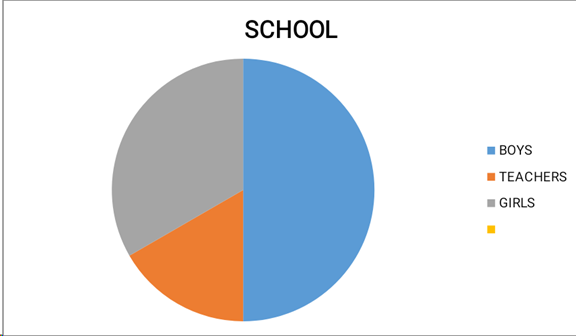
- Use the information below to answer questions 11-14
- 11. The population of a school is 12,000 represented by the pie chart below11.What is the population of boys (a)6,000 (b(8,000 (c)3000 (d)4000
- 12.What is the Population of Teachers(a)1000 (b)3000(c)4000(d)2000
- 13.What is the total population of boys and girls (a)10000(b)3000(c)9000(d)11000
- 14.What is the percentage of Teachers(A)33.3% (b)16.7% (c)50%(d)70%
- 15.Which of the following is a non-banking sector (a)GTBank (b)JAIZ Bank(c)IICO Assurance (d)Zenith Bank
ECONOMICS EXAM QUESTIONS FOR SS2 SECOND TERM
SECTION B
Answer all the questions
- What is a perfect competition?
- With the aid of diagrams, discuss the equilibrium position of a perfect competitive firm
- Distinguish between location of industry and localization of industry
- Describe any four factors which influence the location of industries
- Distinguish between Fixed and Variable cost
- Under which conditions will a firm continue to operate at a loss in the
short run
- Define Labour
- Give four factors that affect the efficiency of labour in your
SS2 ECONOMICS EXAM QUESTIONS SECOND TERM – EDUDELIGHT.COM


