BIOLOGY EXAM QUESTIONS FOR SS2 FIRST TERM
FIRST TERM SS2 BIOLOGY EXAMINATION QUESTIONS – EDUDELIGHT.COM
FIRST TERM EXAMINATION BIOLOGY
SUBJECT: BIOLOGY TIME: 1HR 30MINS CLASS: SS 2
1.Euglena moves by A. whipping action of flagellum B. beating of its cilia C. pushing out a jet of water D. beating the pseudopodia and cilia simultaneously.
2.The organelle which eliminates water from the body of protozoa is A. plasma membrane B. contractile vacuole C .cell wall D. protoplasm.
3.Which of the following is not present in the nucleus of a cell? A .chromosome B. nucleolus C. mitochondrion D. gene
4.In a unicellular organisms, essential nutrients can be transported directly to all part of the body by the process of diffusion only because unicellular organisms have A. a large surface area to volume B. a large volume to surface area C. permeable cell membrane D. outer membrane made of cellulose.
The diagram below illustrates the structure o a unicellular organism. Use the question to answer number6-9.
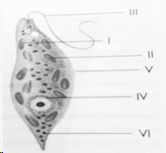
5.What is the name of the organism? A. amoeba B. paramecium C. euglena D. chlamydomonas
6.What is the biological function of labeled part III? A. reproduction B. osmoregulation C. locomotion D. irritability
7.Which of the labeled part does the organism uses for photosynthesis? A. II B. IV C.VI D.V
8.The part labeled V is used for A. photosynthesis B. respiration C. excretion D .irritability
9..Euglena may be classified as plants because it A. has chloroplast B. has a gullet C. lives in water D. possesses flagellum
10. Which of the cell inclusions can destroy other cell organelles? A. centriole B. ribosome C. lysosome D. mitochondria
11.In which of the following tissues will osmosis occurs? A. boiled and peeled yam B. raw and peeled yam C. boiled and unpeeled yam D. roasted and peeled yam
12.Spirogyra is regarded as a multi-cellular plant because A. the cylindrical cells are linked end to end B.its cells are linked together by cytoplasmic strands C. its cells are large D. it is an algae containing a large vacuole
13.The name of the enzyme that catalyzes the conversion of glucose to glucose-6-phosphate at the beginning of the glycolysis is A. phosphate –fructokinase B. glucose isomerase C. hexokinase D.glucose-6- kina
14.Which of the following organism is one celled and free- living? A. volvox B.spirogyra
C .rhizopus D. chlamydomonas
15.Which structure in amoeba performs similar function as the kidney in higher animals? A. cell membrane B. contractile vacuole C. cytoplasm D. food vacuole
16.The function of ribosome in a cell is A. protein synthesis B. starch synthesis C. transport of materials D. lipid storage
17.The fundamental unit of living organism is the A. cell B. organ C. tissue D. nucleolus
18.Movement of water across a semi- permeable membrane from a weaker solution to a stronger solution is known as A. transpiration B. diffusion C. osmosis D. haemolysis
19.Which of the following organelles is referred to as “suicide bay”? A. mitochondria B. lysosome C .golgi body D. ribosome.
20. A spirogyra cell was placed in solution X. After 1 minute it has been plasmolysed . Solution X was A. tap water B. very strong solution C. a very a weak solution D. a weak solution
21.Which of the following organisms can exist as a colony? A. spirogyra B. amoeba C. volvox Paramecium
22.The mode of feeding in green plant is A. parasitic B. saprophytic C .holozoic D.holophytic
23.Mitosis can be observed in all of these except in A. tip of shoot B. nail of a man C. horn of cattle D. sperm cell of man
24. Glycolysis takes place in the A. nucleus B. cytoplasm C. mitochondrion D. endoplasmic reticulum


25.Which of the following does not reproduce by conjugation? A.paramecium B.mucor C .rhizopus D .amoeba
26.All the following are types of asexual reproduction except A .conjugation B. fragmentation C. fission D. budding
27.Which of the following processes involves gamete formation? A. binary fission B.conjugation C.mitosis D.meiosis
28.Which of the following is not a cell organelle ? A.endoplasmic reticulum B.fat droplet C.golgi body D. ribosome
29. Which of the following is not a type of response ? A .chemotropism B. geotropism
C. genotropism D .thigmotropism
30.A plant that can commonly undergo vegetative propagation by means of leaves is A. hibiscus B bryophylum C. crotalaria D. spirogyra.
31.Which of these scientists is not associated with cell theory? A. Felix Dujardin B. Mathias Schleiden C. Micheal Faraday D. Robert Hooke.
32.In mammals , fertilization takes place in the A. ovary B.oviduct C.uterus D.vagina
33.Which of the following stores sperm? A.cowper”s gland B. epididymis C. seminal fluid
D. vas deferens
34.The end product of glycolysis is ………..acid A. fumaric B. pyruvic C. isometric D.sussinic.
35.Yeast reproduces by a process called A .binary fission B. binary fusion C. budding D.conjugation
36.The process that leads to the bursting of red blood cells placed in a hypotonic solution is called A.cyclosis B.haemolysis C. osmosis D. plasmolysis
37.Respiration requiring oxygen is known as A. oxidation B.aerobic respiration C.anaerobic respiration D .oxidation- reduction respiration
38.All the following are methods of artificial vegetative propagation except A.cutting B.use of modified leaves C.marcotting D.grafting.
39.The unit contain in a cell structure responsible for a change in form and shape of an organism is called A.mitochondria B.gene C.ribosome D.lysosome
40.The plant cell mostly stores food as A. glycogen B.auxin C.hormones D.starch
41.All the following organelles have membranes except A .nucleus B .vacuoles C. cell membrane D .cell wall.
42. The cell wall of plants is rigid due to the presence of A.canbium B. cellulose C. cortex D. chloroplast
43.The structure responsible for the transportation of materials within the cell is A. ribosome B. cell membrane C .endoplasmic reticulum D. nucleus
44.Which of these is an anabolic process? A.digestion B.respiration C.decompsition D. growth.
45.In anaerobic respiration in yeast, the pyruvic acid is converted to A .ethanoic acid B. lactic acid C.tri-carbocylic acid D. ethanol
46.Cellular respiration occurs in the A. chloroplast B. food vacuole C. mitochondria D. nucleus
47.In osmosis, when the concentration of the two solutions become equal ,the solution is said to be A. hypertonic B .hypotonic C. isotonic D. neutral
48.Diffusion can be affected by all of following except A .concentration gradient B. size of the molecules C. temperature D.colour of the solution
49.In tissue respiration, energy is in form of A .adenosine diphosphate(ADP) B. glycogen
C. starch D.adenosine triphosphate(ATP)
50.At what stage of mitosis are the chromosomes drawn to the middle A .prophase B. anaphase C. metaphase D.telophase
FIRST TERM SS2 BIOLOGY EXAMINATION QUESTIONS – EDUDELIGHT.COM
THEORY; ANSWER 3 QUESTIONS ONLY.
1a.Make a well labeled diagram of a typical plant cell (10-12cm) long to show its external features (4mks).
B .List four ways in which plant cell and animal cell differ(4mks)
c. State one function each of the following cell organelles (i) chloroplast (ii)ribosome (iii) pyrenoid (iv) mitochondrion(2mks)
2a.Define (i) osmosis (ii) Diffusion (iii) plasmolysis (3mks)
B .Describe what happens when red blood cells are left for thirty minutes in (I ) distilled water (ii) salt solution with same concentration as the cytoplasmic fluid(3mks)
c. Explain the process of osmosis using a living cell (2mks
d. Explain the following terms (1) tactic response (ii) nastic response (2mks
3a. Explain the following mode of nutrition in plant (i) photosynthesis (ii) chemosynthesis (2mks)
b .Write a chemical equation representing the type of respiration that occurs in the muscles during a strenuous exercise (3mk)
ci.Describe an experiment to show the effect of plasmolysis on a fresh filament of spirogyra(2mks)
cii.How can the process be reversed(1mk)
d.. Define the term catabolism and two biological processes that are catabolic in nature(2mks)
4a.Use chemical equation only to express the process of cellular respiration(2mks)
b .Name the structure in a cell in which ATP is formed(1mk)
c. In tabular form state the differences between aerobic and anaerobic respiration(3mks)
d. Explain alcoholic fermentation (4mks)
5a.Define reproduction (2mks)
(ii) List all forms of asexual reproduction (3mks)
b. Describe the process of sexual reproduction in spirogyra (3mks)
c. Mention two parts of plant where mitosis takes place (2mks).
FIRST TERM SS2 BIOLOGY EXAMINATION QUESTIONS – EDUDELIGHT.COM


Thanks this really help me
This was very helpful ☺️☺️☺️
Love this!!!
Its very helpful but where can i find the ones for test
This question help me in my exam so i want to use this medium to say a big thank you
It’s helpful and enlightening